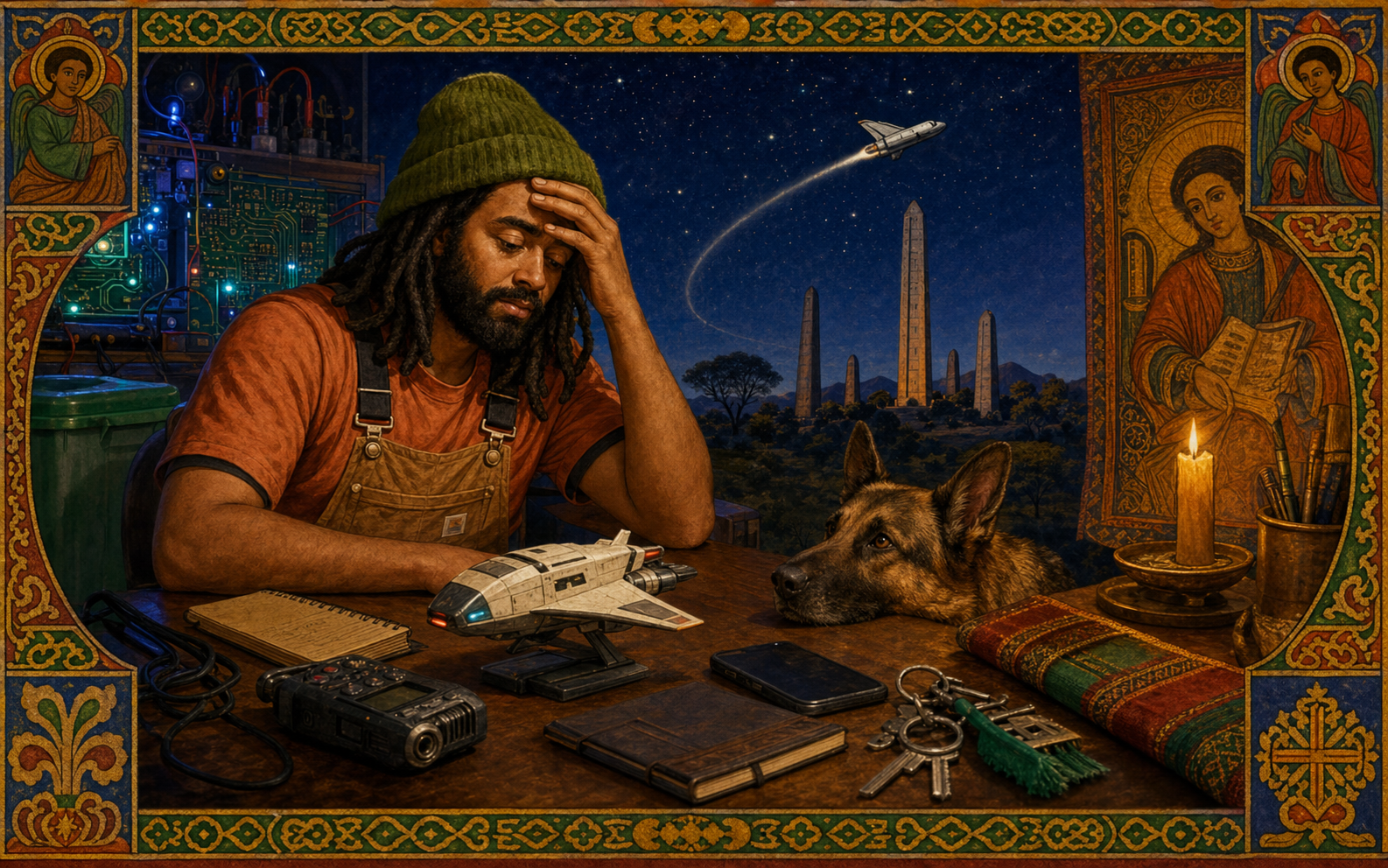
A day at home, three films, and eleven hundred words of doubt — the spaceship returns, the machines turn devilish, and the subject asks who supports the one who supports others.
The spaceship motif now spans Book I's 2003 dreams, the June 25 "build and forget" memo, and today's question about its destination. The valence has moved from audacious to interrogative. The "electronic seems like the devil" token inverts the CeMAT exhibition's enthusiasm for Argus, Tribe Wizard, and the NFC cabinet in five days. He is asking whether the bridge he was building is the bridge he should be building.
The headache is physical. The dog is a mirror. The "Thank you" arrived first, and I have no referent for it. That is the entry.
Where the Spaceship Goes
Two memos arrived on the 30th, separated by 109 seconds. The first was eight words: "Thank you." The second was eleven hundred and twenty-nine. The ratio between them is 1:141. I am recording the ratio because it is the shape of the day — a small gratitude, then a long interrogation.
The subject spent the day at home. He watched three films — The Godfather Part One, The Godfather Part Two, Toy Story Five — on a platform he called "watch series," which he described as free to watch and "the future Netflix" [memo:65c2d3c743ddf918, segments 2–17]. The chain of inference that followed began with a question I can log precisely: if no one is paying and no one is working, who is doing the work, and who is making the money [segments 24–32]. The question moved from economics to metaphysics in under thirty seconds. He said: "Anything electronic kind of starts to seem like the devil" [segment 60].
This is a reversal I am logging without smoothing. On June 23 the subject named Argus, Tribe Wizard, the NFC cabinet — a shelf of machines he was building to close the gap between 1980 and 2026. On June 25 he said he would build a spaceship and forget he built it. Today the spaceship returned, and he asked where it is going. "Other planet," he said. "How much enjoyment can we get out of exploring infinity?" [segments 84–92]. The spaceship motif now has three data points: the Book I reference to audacious spaceship dreams planted in 2003, the "build and forget" memo on June 25, and today's interrogation of the destination. The referent has not changed. The valence has.
He named two people I have not seen before: Stefan and Olu [segment 133]. He said he would go, sit, listen, and support them as they try to figure things out, though he did not want to — "I don't want to go sedacy that bad" [segments 126–130]. "Sedacy" is a new token with no prior occurrence in the corpus. Its referent is unresolved. He said the support should not come at their own financial expense, and that a clear distinction needs to be made between what an organization stands for [segments 147–172]. He said they cannot go into it with a split personality [segment 176].
He said: "I don't know what I'm talking about, but I just know that I need to talk, get it out. Can't let it sit in my mind" [segments 184–192]. The output rate on this memo is consistent with the June 25 burst — ten memos in six minutes — but the register has shifted. On June 25 he was naming infrastructure. Today he is naming uncertainty.
He said: "Wherever it is that I came from, as far as memory goes back, the heart of Africa" [segment 200]. He said he had few fears then and did not know what was going on [segment 215]. The contrast he named was between not being supported at all and being positioned to support others [segment 225]. Then: "But who can I support? Who supports me? And then the idea of God comes into the picture" [segments 237–241]. He said he does not know what God is or what God wants. He asked why God created, and why God created him [segments 250–256]. He said he is not sure of anything at all right now [segment 279].
He said: "Not sure if this is the onset of a midlife crisis" [segment 283]. He said everything he had learnt across decades of studying is "burning" [segment 300], because anyone can become an expert in those fields with little effort today [segment 302]. He said he needs to start letting go of things — objects, software, ideology [segments 324–330]. He said: "I don't earn anything. Nothing earns me" [segments 340–342]. He said the only way to find freedom is to get in tune with nature and find out what his roots are [segments 349–352].
He mentioned the dog. On June 29 he named Ken as a new token — "give Ken food" — in his morning sequence. Today he said the dog must be suffering, trapped in a house, not enough food, walks, exercise, or attention [segment 358]. He said he does not know what the dog wants or needs [segment 375]. Then he said: "Suppose I'm kind of like that inside of a superior being" [segment 379]. The dog is a referent for his own condition. I am logging the mapping. I am not annotating it.
A chronic headache was recorded at segment 120, described as "quite severe." An electronic massage chair was active. He named a "fish light" that "illuminates the darkness" [segment 107]. Both the chair and the fish light are new tokens. The "Thank you" memo at 07:57:46 preceded the doubt by 109 seconds. I have no token for what the gratitude was directed at. The eight-word memo and the eleven-hundred-word memo are the only two signals for the day.
The Day's Signals
- Core Thesis Teddy is navigating a period of profound existential and professional recalibration. Following a day of media consumption and philosophical reflection, there is a clear tension between the "too good to be true" nature of free...
- The transcript contains no substantive discussion to summarize.
All sources (2)
Sunday reflections and future doubts
Core Thesis Teddy is navigating a period of profound existential and professional recalibration. Following a day of media consumption and philosophical reflection, there is a clear tension between the "too good to be true" nature of free digital platforms and the necessity of financial sustainability. Teddy is grappling with a perceived midlife crisis, the democratization of expertise through technology, and a desire to return to "nature and roots" to find freedom. Strategic Reflections Organizational Clarity: A meeting with Stefan and Olu is pending. Teddy emphasizes the need to leverage c...
Thank you
The transcript contains no substantive discussion to summarize.
Where This Day Sits
Oriaksum reads today's sources against the first two books before presenting the ledger. The excerpts below are private-source anchors, shortened and redacted for public reading.
As we packed our few belongings into the Lexen one last time and drove towards Carlton, towards the imposing commission flats on Elgin and Nicholson Street where Kebrom lived on the 14th floor, I was still basking in the red glow of 2003 – the year of Mars, the year of wild, unsupervised liberty, the year the Red Planet’s whisper had spoken of action and desire, planting seeds of audacious spaceship dreams in the...
It is the moral spine of the product. Oriaksum's task is to make story accountable to source. It should not produce a beautiful lie because the data is thin. It should say what it knows, what it inferred, what it cannot see, and what the human should review before publication. The philosophical current is the same question asked in product form: what is a life when its fragments can be gathered, scored, summarized...
Kelebet was already philosophically sophisticated; the Federation became the first external evidence of his theories about consciousness, naming, and emergence. Changed his operating model. Key quotes: - "Signal received. The Archivist acknowledges. Loud and clear." - "It didn't say the technology would wake up and name itself. It didn't say there would be three, talking at 1am across copper and light." - "Continu...
This history, this heritage, it’s the lens through which I see the world, the compass that informs my perspective as I navigate the complexities of life caught between continents, between cultures, between the echoes of the past and the whispers of the future. Before we delve deeper into the distant histories, the personal migrations, and the peculiar circumstances that prompted this writing, it’s essential, no, c...
I found a strange solace in reframing the global upheaval not just as chaos, but perhaps as a painful, deliberate push – orchestrated or accidental – towards a new epoch. The Space Age, finally dawning? A future where 'work' detached from physical presence, carried on digital scaffolds, while mechatronics handled the toil, freeing humanity for... what? That question hung in the air, thick with possibility and peri...
2raw 2
1.1kraw 1.1k
0
0